How to talk about money as a couple
Money is one of the hardest things for couples to talk about, often because it's tied up with how we grew up, how secure we feel and what we think is fair. Talking about it early and often makes it much easier.
Updated 13 November 2026 · 5 min read
The short answer
Pick a relaxed time, suggest it in advance and start with something low-stakes, such as what you'd each like to save for. Talk about the numbers rather than the person, and keep the first conversation short. Then keep talking with a short monthly check-in.
Starting the conversation
Pick a good moment. Not straight after an unexpected bill, not late at night and not in front of friends. Suggest a time in advance: "Can we have a chat about money at the weekend? Nothing's wrong, I'd just like us to be on the same page."
Start with something low-stakes, such as what you'd each love to save for, before getting to debts or worries. Talking about hopes first makes the harder parts easier.
Keep the first talk short and don't try to fix everything. The aim is to get used to talking about money, not to produce a perfect budget. You can come back to the details another day.
Tip: Not sure where to start? In Jointwise, "What matters to you both" is a two-minute quiz: each of you picks your top three money priorities on your own, then you see what you share.
Money histories and habits
Each of you brings habits from how you grew up. One of you might have had a mum who budgeted every penny. The other might have grown up never talking about money at all. Neither is wrong, but the difference explains a lot.
- How was money talked about in your family when you were growing up?
- Did money feel tight, comfortable or unpredictable?
- What's your first memory of spending your own money?
- Are you more of a saver or a spender? Has that changed?
- What does feeling secure with money look like to you?
- What's one money habit of yours you'd like to change?
Avoiding blame
Most money arguments are less about the money and more about feeling judged. A few habits make a real difference.
- Use "I" rather than "you": "I get worried when the account is low before payday" rather than "You always overspend".
- Stick to one topic at a time. Don't bring up last year's holiday when you're talking about this month's food shop.
- Ask questions before drawing conclusions.
- Assume good intentions. You're both trying to look after your future, even if you'd do it differently.
- Take a break if it gets heated, and agree a time to come back to it.
Agree a heads-up limit
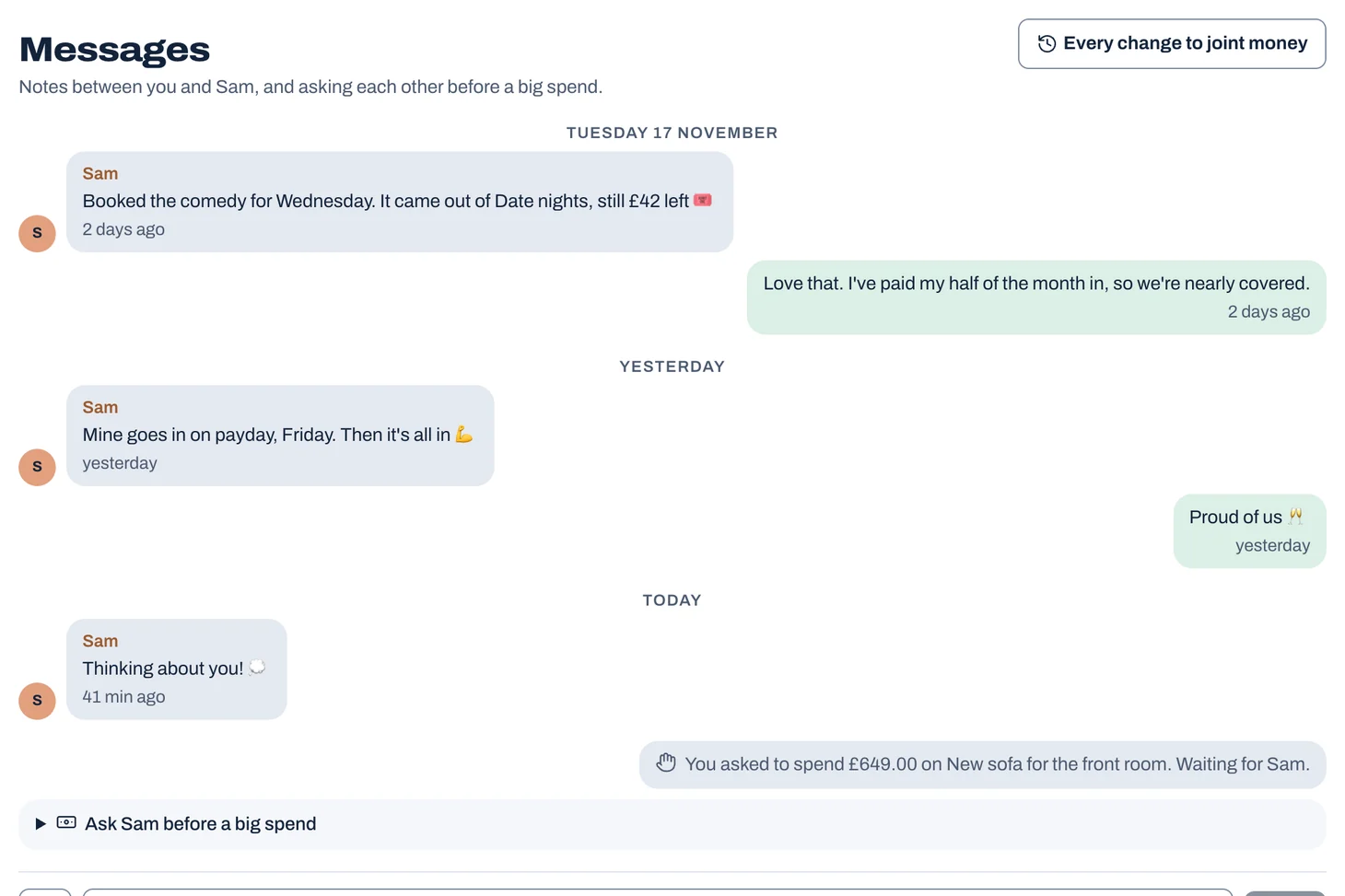
A heads-up limit is an amount above which you'll check with each other before spending. It avoids surprises and stops small purchases from needing permission.
Example: you agree on £150. Buying a coat for £80 needs no discussion. A new phone for £400 gets a quick "can we?" message first. The limit can be different for shared money and personal money.
Agree what counts: a single purchase, or several smaller ones on the same thing? Should subscriptions count by their monthly or yearly cost?
A heads-up isn't about asking permission. It's about not surprising each other. Most of the time the answer will be yes, and the habit means the bigger conversations come up naturally.
Tap to see it full size
Bigger conversations to have at some point
You don't need to cover these in one sitting, but it helps to know where you each stand before they become urgent.
- Whether, when and where you'd like to buy a home, and how you'd share the deposit.
- Whether you want children, and how you'd manage if one of you took time off work.
- How you'd help family, such as supporting a parent or lending money to a sibling.
- What retirement looks like to each of you, and whether you're both saving for it.
- What you'd each want to happen to shared money if you separated.
- Whether to marry or not, and what that would change about your money.
Keep talking
One big talk won't cover everything. A short monthly money check-in keeps things up to date and means problems come up while they're still small. Put it in your shared calendar so it happens.
Small, everyday chats count too. Mentioning that a bill has gone up, or that you'd like to save for something, keeps money an ordinary topic rather than a tense one.
When to get help
If money worries are affecting your sleep, your health or your relationship, it's worth getting support. MoneyHelper has free guidance on money and relationships, and can point you to free debt advice. If you keep having the same argument, a relationship counsellor can help you both feel heard.
If one partner controls all the money, stops the other from having any, or uses money to frighten or punish, that is financial abuse. Organisations such as Surviving Economic Abuse offer information and support.
Common questions
How do you start a money conversation with your partner?
Suggest a time in advance and make it clear nothing is wrong. Choose a moment when you're both relaxed, not straight after a big bill or late at night. Start with hopes, such as what you'd like to save for, before moving on to debts or worries.
Should couples tell each other about their debts?
It's usually worth sharing any debts and what they cost each month, especially before you borrow together or move in. Debts affect what you can afford as a couple. If it feels hard to raise, saying "this is hard for me to talk about" is a good way to start.
What is a heads-up limit for spending?
A heads-up limit is an amount above which you check with each other before buying something. For example, with a £150 limit, an £80 coat needs no discussion, but a £400 phone gets a quick message first. It's about avoiding surprises, not asking permission.
Do couples need to share all their spending?
No. Many couples share their take-home pay, debts, big upcoming costs and shared bills, and keep day-to-day personal spending to themselves. Having some money that's just yours can make the shared part easier. Jointwise keeps personal spending private unless you choose to share it.
What is financial abuse in a relationship?
Financial abuse is when one partner controls all the money, stops the other from having any, or uses money to frighten or punish them. It is a form of domestic abuse. Organisations such as Surviving Economic Abuse offer information and support.
Not financial advice. Jointwise gives you tools and general information to manage money together. It isn't regulated financial advice. It doesn't know your full circumstances.
How Jointwise helps
More on talking about money
Talking about money3 min read
How to tell your partner about debt
How to tell your partner you have debt: what to prepare, what to say, how your debt affects them in the UK, and how to make a plan to pay it off together.
Talking about money5 min read
When your partner spends more than you, and it's starting to grate
One of you saves, one of you spends, and it's turning into a row. How to separate shared money from own money, agree a limit for big buys, and stop keeping score.
Talking about money5 min read
How to run a monthly money check-in
A short monthly money talk keeps you both on the same page. When to have it, an agenda, questions to ask and how to agree what happens next.
Sort your money together tonight.
Set it up in one evening and invite your partner with a link. Your 30 free days start when they join.
No card to start. Nothing deleted if you stop. Either of you can leave any time.