How to run a monthly money check-in
A monthly money check-in is a short, planned talk about how the month went and what's coming up. Done regularly, it means money stops being something you only discuss when there's a problem.
Updated 13 November 2026 · 5 min read
The short answer
A monthly money check-in is a talk of about 45 minutes, held a few days after you've both been paid. You look at last month's spending and savings, check what's coming up and agree one to three actions. Each thinking about it privately first helps you both have a say.
When to have it
Pick a regular slot a few days after you've both been paid, so you can see what came in and what's already gone out. The first weekend after payday works for many couples.
Put it in your shared calendar as a repeating event. If it's planned, it's much less likely to feel like an ambush.
Choose a time when you're both rested and not in a hurry. A Sunday morning with coffee tends to go better than a Wednesday night after a long day.
Before your first one
The first check-in can feel awkward, especially if you haven't talked much about money before. Keep it light. Agree in advance that it's not about blame, and that either of you can pause it.
Gather a few things beforehand: last month's bank statements or a spending summary, the balance of any savings and debts, and a list of bills coming up. You don't need everything perfect. A rough picture is enough to start.
If one of you is dreading it, say so, and ask what would make it easier. Shorter, with a walk afterwards? Starting with savings instead of spending? Small changes help.
How long it should take
Aim for about 45 minutes, then stop. That's long enough to look at the month properly and short enough that neither of you dreads it.
If a big topic comes up, such as a house move or a new baby, note it and book a separate time to talk it through. The monthly check-in works best when it stays short and regular.
If you miss a month, don't try to catch up on two months at once. Just pick up from where you are. A short check-in that happens beats a long one that keeps getting put off.
Jointwise has a two-minute check-in for busy months: three numbers and one question, each on your own phone. It covers the basics until you can sit down properly.
Reflect privately first
Before you talk, each take five minutes to answer a few questions on your own. This gives the quieter person time to think, and stops the first person to speak from setting the tone for both of you.
It also helps you notice when you feel differently about the same thing. One of you might think the month went fine while the other is worried about the credit card. Finding that out early is the point.
Keep the private questions simple. How do you feel about this month? What went well? What's on your mind for next month? Is there anything you'd like to raise? Then compare answers when you sit down together, starting with the parts you agree on.
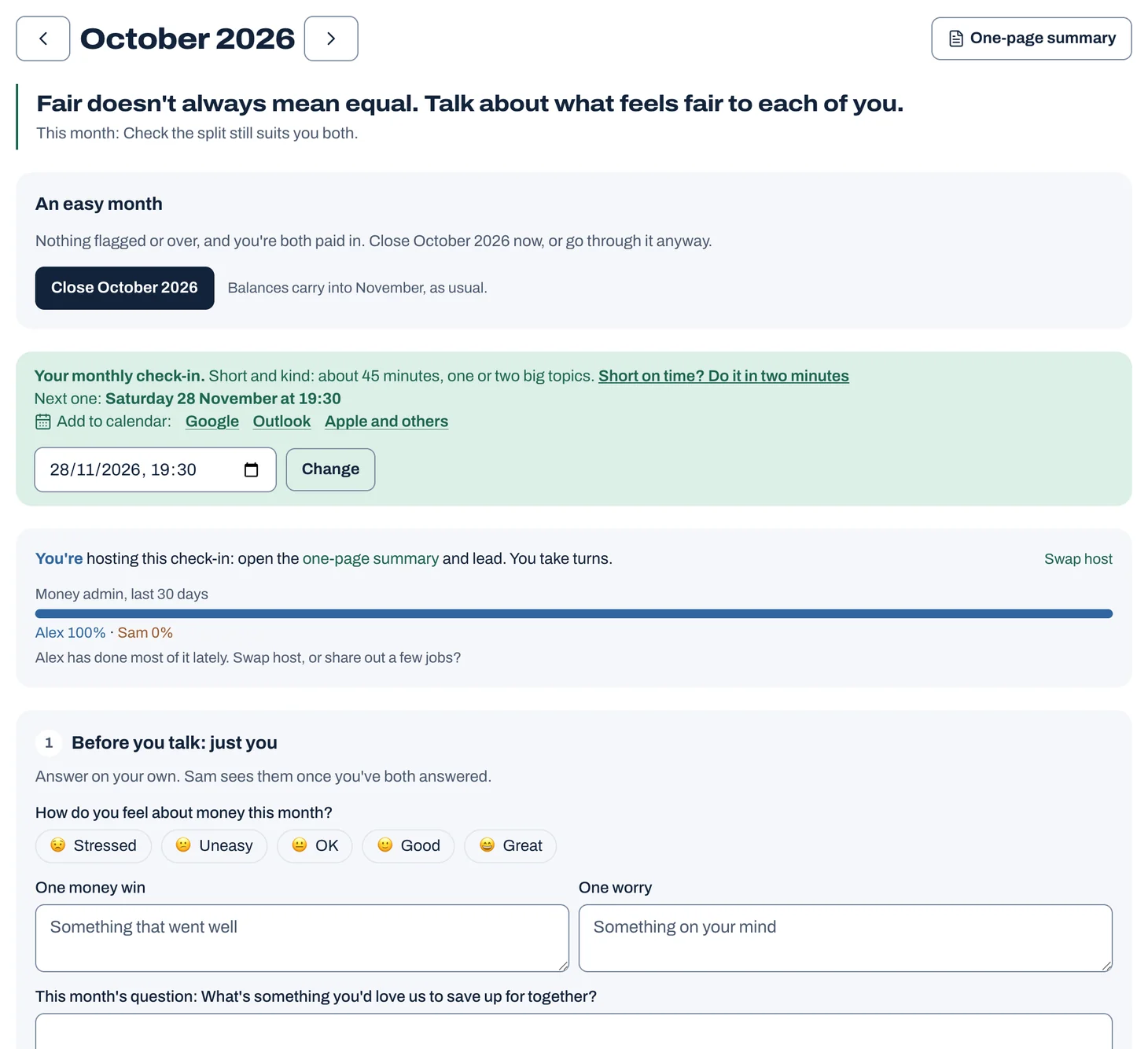
Tap to see it full size
A simple agenda
- Start with something that went well: a bill you cleared, a pot that grew, a date you enjoyed.
- Look at last month's spending against your budget. Where did you spend more or less than planned?
- Check your savings pots and any debts. Are they moving the way you hoped?
- Look at the month ahead: birthdays, yearly bills, trips, the car's MOT.
- Share anything that's been on your mind, from both of your private answers.
- Agree one to three actions, and who will do each.
Tip: Jointwise's check-in follows the same shape, with a step to tidy up uncategorised spending and one for who owes what. It ends with Close the month: settle up, or carry what's owed into next month.
Questions to ask each other
- How do you feel about money this month, in a word or two?
- Was there anything you bought that you're really glad about?
- Was there anything you wish we'd spent differently?
- Is anything coming up that's worrying you?
- Is our bill split still feeling fair?
- What's one thing we're saving for that you're excited about?
- Is there anything you'd like me to check with you before buying?
- Did any bill go up this month without us noticing?
- Are we putting enough aside for yearly costs like car insurance and Christmas?
- Is there a subscription or membership we don't use any more?
Keeping it friendly
The aim is to understand each other, not to win. A few habits help.
- Talk about the numbers, not the person. "Food went over by £80" is easier to hear than "you spent too much on food".
- Ask before explaining. "What happened with the car costs?" opens a conversation. A lecture closes one.
- Keep personal spending personal. If you've agreed some money is each person's own, don't go through it line by line.
- Stop if it gets heated. Agree to come back to it the next day.
Tip: Finish with something to look forward to, such as picking your next date night from what's left in the date budget.
Agreeing actions
End with a short list of things you'll each do, and write them down where you'll both see them. Keep it small: one to three actions is plenty.
Good actions are specific. "Cancel the streaming service we don't watch", "Move £50 more into the holiday pot" or "Ring the energy company about the bill" are easy to check next month. "Spend less" isn't.
At the start of the next check-in, look at last month's actions first. Ticking them off is a good way to begin.
If an action keeps getting carried over, talk about why. It might be too big, or it might not matter as much as you thought. Either break it into a smaller step or drop it.
Common questions
How often should couples talk about money?
A short planned talk once a month works for many couples, a few days after you've both been paid. Small everyday chats in between help too, such as mentioning a bill that's gone up. Talking regularly means problems come up while they're still small.
What should you talk about in a money check-in?
Start with something that went well, then look at last month's spending against your budget. Check your savings and debts, look at costs coming up next month, and share anything that's on your mind. Finish by agreeing one to three specific actions and who will do each.
How long should a money check-in take?
About 45 minutes is enough for most couples. That's long enough to look at the month properly without it dragging. If a big topic comes up, such as moving house, book a separate time to talk it through.
What if we miss a monthly money check-in?
Don't try to cover two months at once. Pick up from where you are now and keep it short. A short check-in that happens is more useful than a long one that keeps getting put off.
Why answer money check-in questions separately first?
Taking five minutes each to answer a few questions alone gives the quieter person time to think. It also stops whoever speaks first from setting the tone for both of you. Jointwise runs monthly check-ins where each person answers privately before you talk.
Not financial advice. Jointwise gives you tools and general information to manage money together. It isn't regulated financial advice. It doesn't know your full circumstances.
How Jointwise helps
More on talking about money
Talking about money5 min read
How to talk about money as a couple
How to start money conversations as a couple: understand each other's money history, avoid blame, decide what to share and agree a heads-up limit.
Talking about money3 min read
How to tell your partner about debt
How to tell your partner you have debt: what to prepare, what to say, how your debt affects them in the UK, and how to make a plan to pay it off together.
Talking about money5 min read
When your partner spends more than you, and it's starting to grate
One of you saves, one of you spends, and it's turning into a row. How to separate shared money from own money, agree a limit for big buys, and stop keeping score.
Sort your money together tonight.
Set it up in one evening and invite your partner with a link. Your 30 free days start when they join.
No card to start. Nothing deleted if you stop. Either of you can leave any time.