How to budget with irregular income
If your pay goes up and down, because of shift work, commission, freelancing or seasonal jobs, a normal monthly budget can feel impossible. The trick is to plan on a quiet month and let the good months build a buffer.
Updated 8 November 2026 · 5 min read
The short answer
Base your budget on a quiet month: an amount you've earned in most months, not your average. In good months, put anything above that into a buffer pot, and top up from it in lean months. If you're self-employed, also set aside money for tax as each payment arrives.
Find a typical quiet month
Look back at the last 6 to 12 months of income. Ignore the very best month and focus on the quieter ones. Pick an amount you've reached in most months, not your average.
Example: over a year, your monthly income ranged from £1,400 to £3,200, but in most months it was at least £1,900. Build your budget on £1,900. Anything above that is extra.
If you're new to irregular pay and don't have a history yet, start cautiously and adjust after a few months.
Set up a buffer pot
A buffer pot smooths out the gaps. In good months, money above your quiet-month figure goes into the buffer. In lean months, you top up from it to reach your quiet-month figure.
Example: you budget on £1,900. In March you earn £2,600, so £700 goes into the buffer. In April you earn £1,500, so you take £400 from the buffer and still have £1,900 to live on.
Aim to build the buffer to at least one month's quiet-month income. Over time, two or three months gives you real breathing room.
Tip: Pay yourself a set amount from the buffer on the same day each month. It makes irregular pay feel like a salary.
Order your spending
In a good month you'll get further down the list. In a quiet month you might stop at step two or three, and that's fine.
- Essentials first: rent or mortgage, council tax, energy, food and travel.
- Minimum debt payments and your share of shared bills.
- Topping up the buffer pot.
- Savings goals.
- Everything else, including treats and nights out.
Plan for quiet seasons and yearly bills
Many irregular incomes follow a pattern. A wedding photographer is busy in summer. A retail worker gets extra shifts before Christmas. Someone on commission might have a slow January every year.
Look for your pattern and plan around it. A simple way is to write down each month's income for the past year in a list and mark the busy and quiet months.
Once you can see the pattern, plan around it. If you know February is always quiet, make sure the buffer is full by the end of the busy months. Hold off on big purchases until after the quiet season, when you know the buffer has held.
Yearly bills need the same care. Car insurance, the TV licence and a boiler service can land in a quiet month. Divide each one by 12 and set that amount aside every month in its own pot, so the money is there whenever the bill arrives.
If you're self-employed: set money aside for tax
When you're self-employed, no one takes tax off your pay for you. You report your income through Self Assessment and pay the bill yourself, usually in one go or in instalments.
Set aside a share of every payment as soon as it arrives, in its own pot that you don't touch. That way the tax bill isn't a shock. If you're not sure how much to put aside, start with a higher amount and adjust once you know your bill.
GOV.UK explains how Self Assessment works, the deadlines, and payments on account, where you pay part of next year's bill in advance. Payments on account can make the first bills bigger than people expect, so it's worth reading about early.
Splitting bills when one income varies
If one of you has a steady salary and the other's pay changes, a split by income can swing wildly from month to month. A few approaches help: use the quiet-month figure, fix contributions for a while, or divide bills by type.
Example: one of you earns a steady £2,400 a month. The other's pay varies, but their quiet-month figure is £1,600. Together that's £4,000, so a split by income is 60/40. On £2,000 of shared bills, that's £1,200 and £800, every month, whatever actually comes in. The person with variable pay tops up from their buffer in lean months and refills it in good ones.
- Use the quiet-month figure for the person with irregular pay, not what they actually earned that month.
- Fix each person's contribution for three or six months, then review.
- Have the person with steady pay cover the fixed bills, while the other covers food and variable costs that are easier to adjust.
- Agree what happens in a very good month. Some couples put part of the extra into a shared pot.
Keep it visible
It also helps to agree how you'll talk about it. The partner with steady pay may not realise how stressful a quiet month can feel, and the partner with irregular pay may feel judged for a slow patch they couldn't control. Treat the buffer as a shared safety net rather than one person's problem.
Irregular income works much better when you can both see what's coming in. Talk briefly when a big payment arrives or a quiet month is coming, so neither of you is caught out.
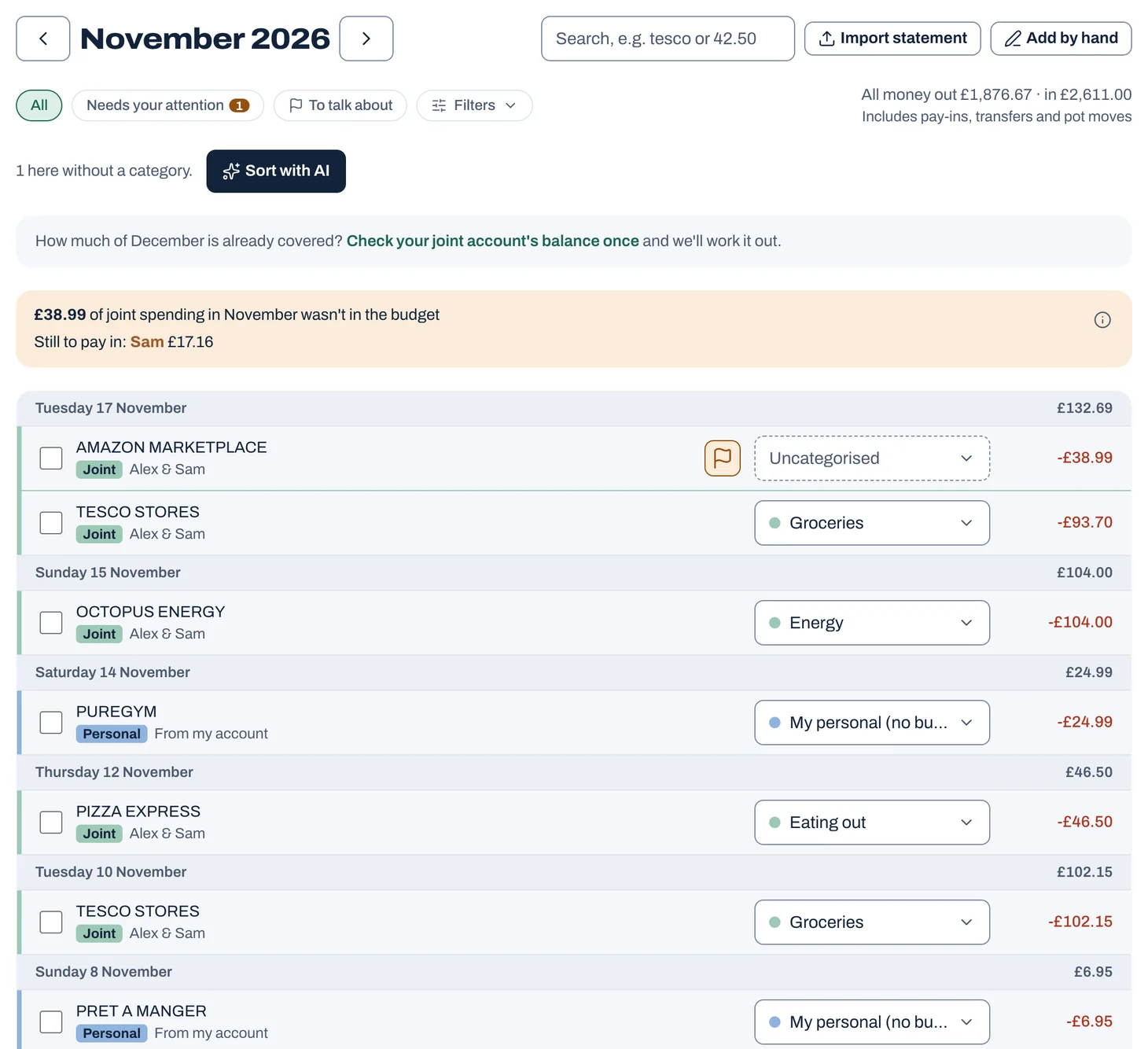
Jointwise lets you budget on a quiet month for irregular pay, with a buffer pot that the good months top up.
Tap to see it full size
Common questions
How do you budget when your income changes every month?
Look back over the last 6 to 12 months and pick an amount you reached in most months. Build your budget on that figure and treat anything above it as extra. Cover essentials first, then minimum debt payments, then the buffer, savings and everything else.
What is a buffer pot?
A buffer pot is savings that smooth out irregular pay. In good months, money above your quiet-month figure goes in, and in lean months you take out enough to reach that figure. Paying yourself the same amount from it each month makes irregular pay feel like a salary.
How big should a buffer be if your income is irregular?
Aim for at least one month of your quiet-month income to start. Over time, two or three months gives you more room for slow patches. If your work has a regular quiet season, make sure the buffer is full before it starts.
How much should self-employed people put aside for tax?
It depends on your income and circumstances, so there isn't one figure for everyone. Set aside a share of each payment in a separate pot as soon as it arrives, and start higher if you're unsure. GOV.UK explains Self Assessment, the deadlines and payments on account, which can make the first bills bigger than expected.
How do couples split bills when one income is irregular?
Use the quiet-month figure for the person with irregular pay when working out a split by income, rather than what they earned that month. That keeps each person's contribution the same every month. The person with variable pay tops up from their buffer in lean months. Jointwise lets you budget on a quiet month, with a buffer pot that the good months top up.
Not financial advice. Jointwise gives you tools and general information to manage money together. It isn't regulated financial advice. It doesn't know your full circumstances. For free, impartial help, visit MoneyHelper. If debts feel unmanageable, StepChange offers free debt advice. For personal recommendations, speak to a regulated financial adviser.
How Jointwise helps
More on saving and big goals
Saving and big goals5 min read
First-time buyer hidden costs: the checklist for couples
What you pay to buy your first home on top of the deposit: stamp duty, legal fees, surveys, mortgage fees and moving. A UK checklist for couples.
Saving and big goals5 min read
Should you save or pay off debt first?
Save or pay off debt? Compare interest rates, build a safety net first, and the usual order for credit cards, loans, student loans and mortgages.
Saving and big goals6 min read
Budgeting for a baby as a couple: the first year
Pay drops, new bills arrive and childcare looms. How couples plan a baby's first year: the one-off buys, the monthly extras, the help to claim, and who pays what.
Sort your money together tonight.
Set it up in one evening and invite your partner with a link. Your 30 free days start when they join.
No card to start. Nothing deleted if you stop. Either of you can leave any time.