Should you save or pay off debt first?
If you have spare money each month, it can go into savings or towards debts. The right answer depends mostly on interest rates, with one important exception: you need a small safety net first.
Updated 26 October 2026 · 5 min read
The short answer
Usually, build a small emergency fund of about one month's essential bills first, then pay off your most expensive debts. Debts such as credit cards normally cost more in interest than savings earn, so clearing them gives the better return. Keep up minimum payments and priority bills throughout.
Compare the interest rates
Debt usually costs more in interest than savings earn. When it does, paying off the debt is like getting a guaranteed return equal to the debt's interest rate.
Example: you have £1,000 on a credit card charging 22% a year, and £1,000 in savings earning 4%. Over a year, the card costs about £220 in interest and the savings earn about £40. Each £100 you move from savings to the card saves about £22 in interest and loses about £4 in savings interest. That's roughly £18 a year better off for every £100 moved.
The higher the rate on the debt, the stronger the case for paying it off. The closer the rates, the less it matters.
To compare, look for the yearly rate on each debt (often shown as APR) and the rate your savings earn. You'll find them on your statements or in your banking app.
Build a safety net first
Before you put everything into debts, keep a small emergency fund. Without one, a broken boiler or a big vet's bill often goes straight back on a credit card.
A good first target is about one month of essential bills: rent or mortgage, council tax, energy, food and travel to work. Once your most expensive debts are cleared, build it up towards about three months.
Keep it in an easy-access savings account, separate from your everyday money, so it's there when you need it and not tempting the rest of the time.
The usual order
- Keep up the minimum payments on every debt and bill, especially priority bills like rent, mortgage, council tax and energy.
- Build a starter safety net of about one month of essential bills.
- Pay off the most expensive debts first, such as payday loans, overdrafts and credit cards.
- Grow your safety net towards about three months of essential bills.
- Pay off cheaper debts, such as personal loans and car finance, if it makes sense.
- Save and invest for longer-term goals.
Tip: Paying the debt with the highest interest rate first usually costs least overall. Clearing the smallest balance first can feel more motivating. Either is far better than not starting.
Debts that work differently
- UK student loans are repaid through your pay once you earn above a threshold, and any balance left is written off after a set number of years, depending on your plan. Because of the write-off, overpaying doesn't always reduce what you repay in total. Whether it makes sense depends on your plan and income. GOV.UK explains the rules for each plan.
- Mortgages are usually the cheapest borrowing you'll have. Overpaying can save interest, but check for early repayment charges first. Many fixed deals allow you to overpay a set amount each year without a charge.
- 0% deals on credit cards or buy now pay later don't stay at 0% forever. Note the date the offer ends and plan to clear the balance before then, or the full rate may apply.
A worked example
Say you have £300 spare each month, £500 in savings, £2,400 on a credit card and essential bills of £1,800 a month.
First, build the safety net to one month of essential bills. You need £1,300 more, so £300 a month gets you there in about four and a half months. Keep paying at least the minimum on the card during this time.
Next, put the £300 towards the card, on top of the minimum payment. That clears it in well under a year, and every pound you pay off stops costing interest straight away.
Once the card is gone, go back to the safety net and build it up towards three months of essential bills. After that, look at cheaper debts and longer-term saving.
Investing and pensions
Once your expensive debts are gone and your safety net is in place, you might think about investing. Investing is generally for money you won't need for at least five years. Its value can go down as well as up, so it isn't a place for your emergency fund.
If your employer pays into your workplace pension when you do, that's extra money for your future. Many people find it worth paying in at least enough to get the full employer contribution, even while clearing other debts. MoneyHelper has free guidance on pensions and on prioritising debts.
Doing it as a couple
Debts from before you met usually stay with the person who took them out. Even so, it helps to see everything in one place, agree a plan, and decide whether to tackle them together or separately.
If one of you is paying off a debt and the other is saving, talk about how that affects your bill split. Some couples agree the person paying off debt puts a little less into shared bills for a while, so the debt clears sooner.
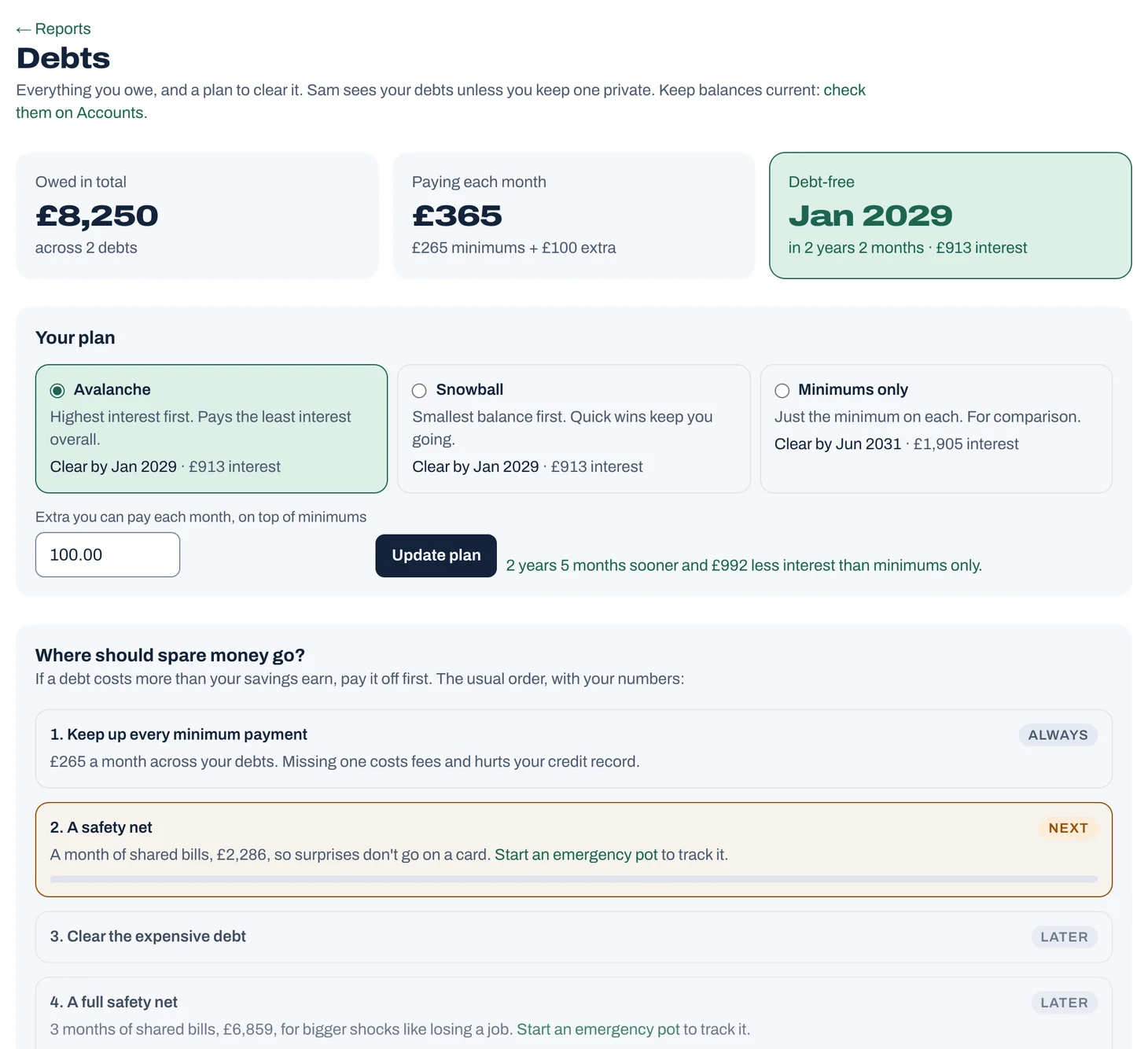
Tap to see it full size
When to get help
If you're only making minimum payments, borrowing to pay bills, or missing payments, talk to a free debt advice service. MoneyHelper can point you to free, confidential help. Avoid companies that charge fees for debt advice you can get free.
Common questions
Is it better to save or pay off a credit card?
Paying off the card usually comes out ahead, because credit card interest is normally much higher than what savings earn. The exception is a small emergency fund, which stops an unexpected bill going straight back on the card. Compare the yearly rate on the card with the rate on your savings to see the difference.
How big should an emergency fund be?
A common first target is about one month of essential bills, such as rent or mortgage, council tax, energy, food and travel to work. Once your expensive debts are cleared, build it towards about three months. Keep it in an easy-access savings account, separate from your everyday money.
Should I overpay my student loan?
Not always. UK student loans are repaid through your pay once you earn above a threshold, and any balance left is written off after a set number of years, depending on your plan. Because of that, overpaying may not reduce what you repay in total. GOV.UK explains the rules for each plan.
Should I overpay my mortgage or save?
Mortgages are usually the cheapest borrowing you have, so most people clear more expensive debts and build a safety net first. If you then want to overpay, check for early repayment charges. Many fixed deals let you overpay a set amount each year without a charge.
Which debt should I pay off first?
Paying the debt with the highest interest rate first usually costs least overall, which often means payday loans, overdrafts and credit cards. Clearing the smallest balance first can feel more motivating. Either way, keep up the minimum on every debt, and if you're struggling, MoneyHelper can point you to free debt advice.
Not financial advice. Jointwise gives you tools and general information to manage money together. It isn't regulated financial advice. It doesn't know your full circumstances. For free, impartial help, visit MoneyHelper. If debts feel unmanageable, StepChange offers free debt advice. For personal recommendations, speak to a regulated financial adviser.
How Jointwise helps
More on saving and big goals
Saving and big goals6 min read
Budgeting for a baby as a couple: the first year
Pay drops, new bills arrive and childcare looms. How couples plan a baby's first year: the one-off buys, the monthly extras, the help to claim, and who pays what.
Saving and big goals5 min read
Wedding budget as a couple: who pays, and how to save for it
Set a wedding budget you both agree on, decide who pays what between you and your families, and save for it in a way that doesn't stall the rest of your plans.
Saving and big goals6 min read
Saving for a house deposit together
How couples in the UK save for a first home deposit: setting the target, splitting what you each put in, Lifetime ISAs, and keeping track of who paid what.
Sort your money together tonight.
Set it up in one evening and invite your partner with a link. Your 30 free days start when they join.
No card to start. Nothing deleted if you stop. Either of you can leave any time.