Should we get a joint bank account?
A joint account can make shared bills simpler, but it isn't the only way to share money as a couple. Here's how the three common setups work, what a joint account means for your credit files, and what to agree before you open one.
Updated 26 October 2026 · 6 min read
The short answer
You don't need one, but it can make shared bills simpler. Many couples keep their own accounts and each pay an agreed amount into a joint account for shared bills. Before you open one, know that it links your credit files and usually makes you both responsible for any overdraft.
Three common setups
Most couples end up with one of three arrangements. None is right or wrong. The best one is the one you both understand and are happy with.
- Fully joint: both salaries are paid into one account and everything comes out of it. It's simple and feels like a team, but neither of you has money that's only yours, and every purchase is visible to the other person.
- Partly joint: you each keep your own account and send an agreed amount into a joint account for shared bills. This is the most common middle ground. Shared costs are covered, and personal spending stays personal.
- Fully separate: no joint account. One person pays a bill and the other pays them back, or you each take certain bills. It keeps things independent, but you need a clear way to track who owes whom.
How a joint account affects your credit files
When you open a joint account with someone, credit reference agencies record a financial link between you. Lenders may then look at your partner's credit file when you apply for credit, and theirs when they apply.
That link usually stays even after you close the account. To remove it, you need to ask each credit reference agency to separate you, often called a notice of disassociation. You can normally only do this once you no longer have any joint accounts or credit together.
If either of you has missed payments, County Court Judgments or a lot of debt, it's worth talking about this before you open the account. It's not a reason to avoid a joint account, but it's better to know.
Who is responsible for what
Most joint accounts make you jointly and severally liable for any overdraft. That means the bank can ask either of you to repay the whole amount, not just your half, even if the other person spent it.
Either account holder can usually withdraw money, make payments and sometimes close the account without asking the other. Banks differ, so read the terms, and ask whether you can set the account so both of you must agree to certain changes.
Tip: If you don't want an overdraft on your joint account, ask the bank to remove it or set it to zero when you open the account.
Which setup suits whom
Fully joint often suits couples who are married or have been together a long time, earn similar amounts or have one main earner, and are comfortable with each other seeing every purchase. It works best when you trust each other's spending habits and talk about money often.
Partly joint suits most couples. It works whether incomes are similar or very different, because you can each put in a different amount. It also leaves each of you some money to spend without explaining it, which many people find makes the shared part easier.
Fully separate can suit couples who've just moved in together, people who've been through a difficult separation before, or couples where one person has debts they'd rather keep apart. It needs more tracking, but it can be a sensible first step before deciding on anything joint.
You can change your mind later. Plenty of couples start separate, add a joint account for bills when they move in, and go fully joint when they have children or buy a home.
What to agree first
- What the account is for: bills only, or bills plus food, holidays and nights out.
- How much each of you puts in, and whether that's 50/50, by income or an agreed share.
- When money goes in, ideally the day after payday for whoever is paid last.
- What happens if there's money left at the end of the month: does it stay as a buffer, go into savings, or get split back?
- Whether you'll allow an overdraft at all.
- What you'd both do if you separated, while it's easy to talk about.
Setting up a partly joint account, step by step
- List your shared bills and add them up. Include yearly costs divided by 12.
- Add a small buffer, for example £50 to £100 a month, so a bigger energy bill doesn't tip you into the red.
- Agree each person's share of the total.
- Open the account together. Most banks let you apply online or in an app if you both already bank with them.
- Set up a standing order from each personal account into the joint account for the day after payday.
- Move direct debits for shared bills across to the joint account, one at a time, and check each one goes out from the right place.
- After two or three months, check the balance. If it's creeping down, raise the amounts. If it's building up, decide what to do with the extra.
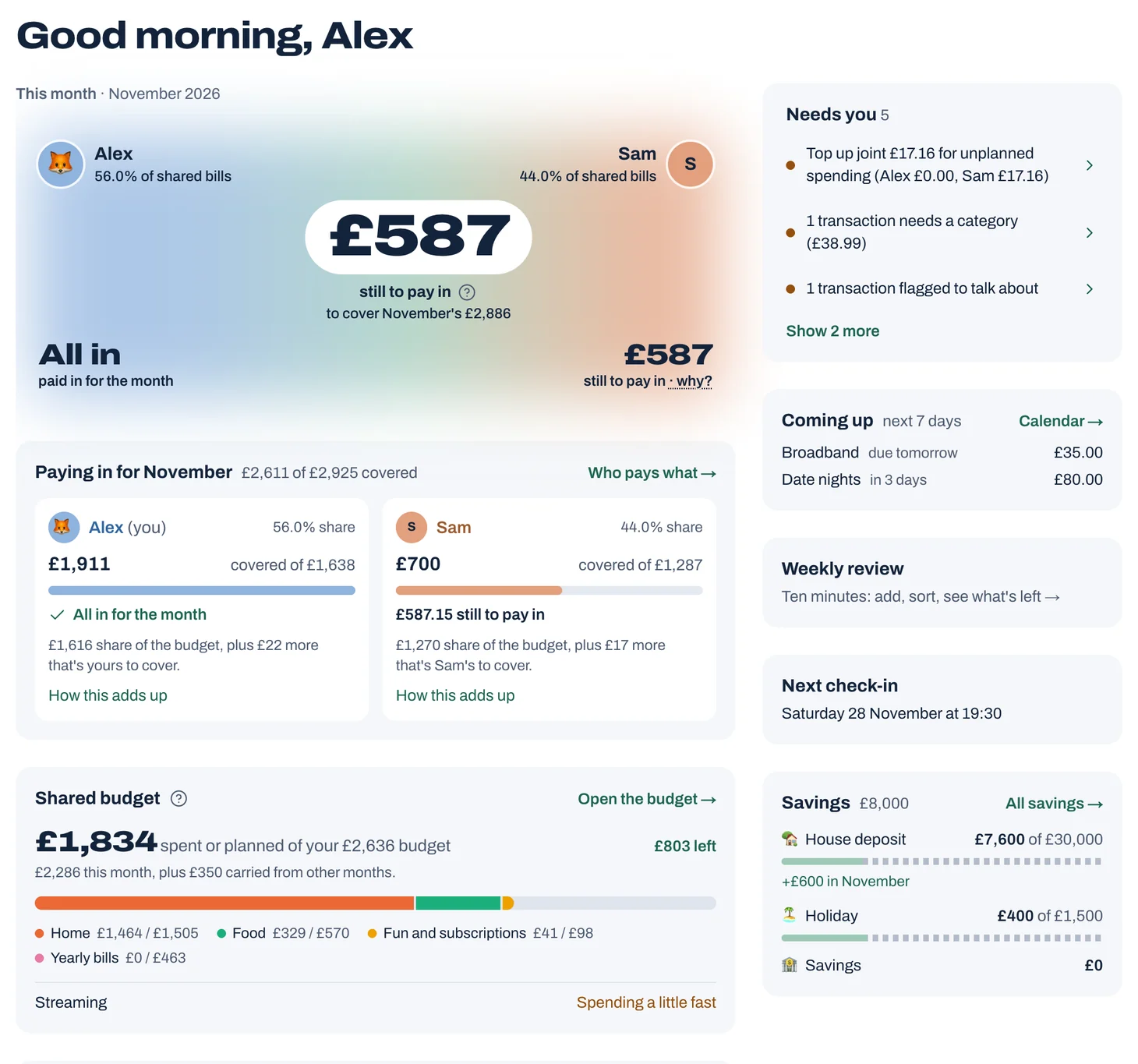
Tap to see it full size
If you'd rather not have one
Plenty of couples share bills well without a joint account. The main thing you lose is having one place where the shared money sits. The main thing you need instead is a clear record of who has paid what, so neither of you ends up quietly out of pocket.
Jointwise works with or without a joint account. It tracks who owes whom across your shared bills, and personal spending stays private unless you choose to share it.
Already have a joint account with an app-based bank? See how its app and Jointwise fit together in Jointwise or your bank's joint account app? Moving in together soon? Start with the moving in together money checklist.
Common questions
Does a joint account affect your credit file?
Opening a joint account creates a financial link between you on your credit files. Lenders may then look at your partner's credit history when you apply for credit, and at yours when they apply. If either of you has missed payments or a lot of debt, talk about it before opening the account.
How do you remove a financial link with an ex-partner?
First close or separate any joint accounts and credit you have together. Then ask each credit reference agency for a notice of disassociation, which removes the link. The link usually stays on your files until you do this, even after the account is closed.
Who pays the overdraft on a joint account?
Most joint accounts make you jointly and severally liable. That means the bank can ask either of you to repay the whole overdraft, not just half, even if the other person spent the money. If you don't want that risk, ask the bank to remove the overdraft or set it to zero.
Can my partner take money out of our joint account without asking?
Usually, yes. Either account holder can normally withdraw money and make payments without the other's permission, and can sometimes close the account. Rules differ between banks, so read the terms and ask whether some changes can need both of you to agree.
Can couples share bills without a joint account?
Yes. One person can pay a bill and the other pays them back, or you can each take certain bills. What you need instead is a clear record of who has paid what. Jointwise tracks who owes whom across your shared bills, with or without a joint account.
Not financial advice. Jointwise gives you tools and general information to manage money together. It isn't regulated financial advice. It doesn't know your full circumstances. For free, impartial help, visit MoneyHelper. If debts feel unmanageable, StepChange offers free debt advice. For personal recommendations, speak to a regulated financial adviser.
How Jointwise helps
More on sharing fairly
Sharing fairly5 min read
How to share chores fairly as a couple
Share household jobs fairly: list every task including the invisible ones, compare time not count, play to preferences and check in regularly.
Sharing fairly6 min read
My partner earns more than me: how should we split the bills?
When one of you earns more, 50/50 leaves the other short. Three fair ways to split the bills, with the same couple worked through each, and how to agree one.
Sharing fairly5 min read
How much should we each put into the joint account?
How to work out what each of you pays into the joint account every month: add up the shared bills and savings, then split the total by income, 50/50 or a share you agree.
Sort your money together tonight.
Set it up in one evening and invite your partner with a link. Your 30 free days start when they join.
No card to start. Nothing deleted if you stop. Either of you can leave any time.